02 Jun

My Little Kerry Cow

‘Tis in Connacht and in Munster, you may travel far and wide,
And be askin’ all the folk you meet along the country side,
But you’ll never meet a one can show the likes of her till now,
Where she’s grazing in the Leinster fields my little Kerry cow.

If herself went to the cattle fair, she’d put all other cows to shame,
And the greatest poets would assemble there, to sing about her fame;
Young girls would be askin’ leave to stroke her satin coat,
They’d be praising and caressing her, and calling her a dote.

If the King of Spain gets news of her, he’ll fill his purse with gold,
And set sail to ask the English King where she is to be sold,
But the King of Spain may come to me, a crown upon his brow,
‘Tis he may keep his golden purse—and I my Kerry cow.

If the Ulster men should hear of her, they’ll come with swords and pikes,
‘Tis civil war—there’ll be no less, if they should see her likes,
And in the papers you will read of the bloody fight there’s been,
And the Orangemen they’re buryin’ in the fields of Leinster green.

Perhaps the Priest will tell her fame to the Holy Pope of Rome,
And the Cardinals’ College send for her to leave her Irish home,
But it’s heart broke she would be herself to cross the Irish sea,
Twould be better they send a blessing for my Kerry cow and me.

There’s red cows that’s contrary, and white cows that’s quare and wild,
But my Kerry cow is biddable, and gentle as a child,
You could raise up kings and heroes on the lovely milk she yields,
For she’s fit to foster generals to lead out battlefields.

In the hist’ries they’ll be making, they’ve a right to put her name,
With the horse of Troy and Odin’s hounds and other beasts of fame,
And artists will be painting her, beneath the hawthorn bough,
Where she’s grazing on the good green grass—my little Kerry cow.

I picked up another hard-to-find songbook recently: North Pennsylvania Minstrelsy: As Sung in the Backwoods Settlements, Hunting Cabins and Lumber Camps in the “Black Foret” of Pennsylvania 184-1923 by Shoemaker. I have come to expect at least a couple tasty morsels of Irish-American song in these books and this one did not disappoint.  This month we have “My Little Kerry Cow” or, as it’s titled in Shoemaker, “My Little Kerry Gow.”

Shoemaker tells us that the text was written down by John C. French of Roulette, PA in 1918. It turns out to be a poem that appeared in 1913 in Songs from Leinster by Dublin-based Anglo-Irish poet Winifred M. Letts (1882-1972). Letts wrote the poem and may have published it in a magazine prior to 1913.  Amazingly, it may have been as little as 5 years old when it was given to Shoemaker in Pennsylvania!

It does seem to have entered tradition as a song. Maureen Melly, daughter of legendary Fermanagh singer Brigid Tunney and sister to Paddy Tunney, sang her version for collectors Seán Ó Baoill and Peter Kennedy in Belfast in 1953. This recording is accessible online on the Oriel Traditional Music Archive (otma.ie).

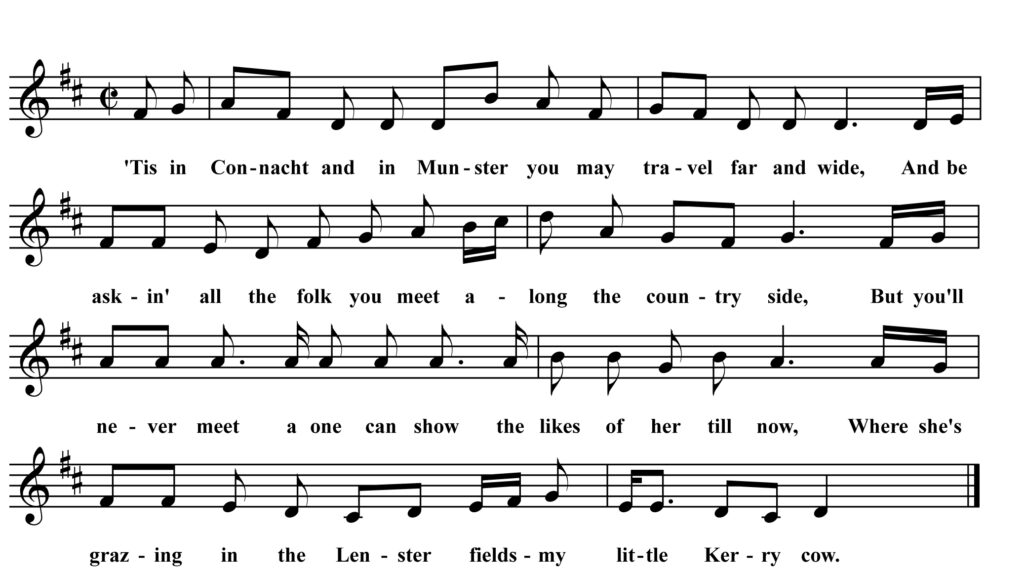
The above is primarily the Pennsylvania text and Melly’s melody with a few words borrowed from Melly and from Letts’ original.
02 Jun

The Banks of Brandywine

One morning very early in the merry month of May,
As I walked forth to take the air, all nature being gay,
The moon had not yet veiled her face but through the trees did shine,
As I wandered for amusement on the banks of Brandywine.

At such an early hour I was surprised to see,
A lovely maid with downcast eyes upon those banks so gay,
I modestly saluted her, she knew not my design,
And requested her sweet company, on the banks of Brandywine.

“O leave me sir do leave me my company forsake
For it is my real opinion you’re nothing but a rake,
My love’s a valiant sailor and he’s out on the brine,
While comfortless I wander on the banks of Brandywine.”

“My dear, why do you thus give up to melancholy cries?
I pray leave off your weeping, and dry those lovely eyes,
For sailors in each port, my dear, they do a mistress find,
He will leave you still to wander on the banks of Brandywine.”

“O leave me, sir, do leave me, why do you me torment?
My Henry won’t deceive me, therefore I am content,
Why do you thus torment me, and cruelly combine,
To fill my heart with horror on the banks of Brandywine?”

“I wish not to affect your mind but rather for to ease,
Such dreadful apprehensions that soon your mind will see,
Your love, my dear, in wedlock bands, another one has joined.”
She swooned into my arms on the banks of Brandywine.

O the lofty hills and craggy rocks re-echoed back her strain,
And the pleasant groves and rural shades gave witness to her pain,
“How often has he promised me in Hymen’s chains to join,
Now I’m a maid forsaken on the banks of Brandywine.”

“O no, my dear, that ne’er shall be, behold your Henry now,
I clasp you to my bosom, love, I have not forgot my vow,
It’s now I know you’re true, my dear, in Hymen’s chains we’ll join
And hail the happy morn we met on the banks of Brandywine.”

We return to the deep well of beautiful songs recorded by collector Helen Creighton in the Canadian Maritimes this month. While browsing around the recently accessible audio collection at the Nova Scotia Archives site I came across this one from singer Berton Young of West Petpeswick, Nova Scotia. Creighton recorded him in 1945.

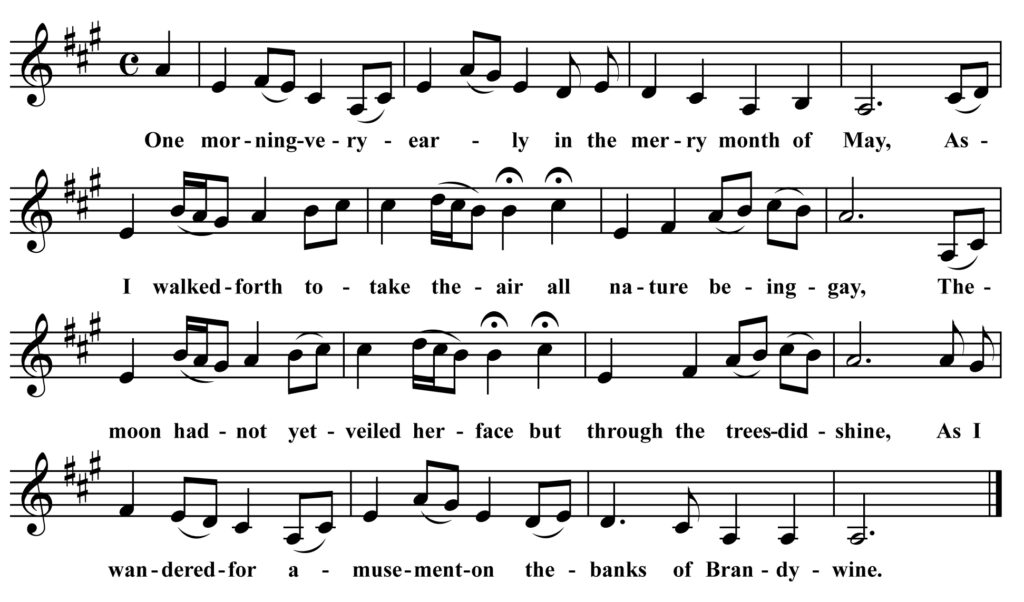
This song appears in Creighton’s book Folk Songs of Nova Scotia in a slightly different form but I made my own transcription of Young’s singing here.  He has trouble remember the words so the recording jumps around a bit but he is another singer from that region who exhibits a fantastic light, ornamented style full of interesting twists and turns. The story is a classic example of a “Riley Ballad” where the returned lover disguises himself and tests the woman’s faithfulness before revealing his identity.

The Brandywine River (creek) referenced is most likely the one in Pennsylvania/Delaware that was the site of an important battle in the American Revolutionary War. That place name points to a North American origin for the song but it does turn up in Ireland as well. Irish song authority John Moulden guesses that it came back with someone who returned to Ireland after working over here.

02 Jun

The Hinckley and Sandstone Fire

You people all, both great and small,
I hope you will draw near
And when you hear of the Hinckley fire,
You will surely drop a tear,
The old pioneers of Hinckley,
Were always in good cheer,
Until a cyclone of fire came that way,
And ended their career.

On the first day of September,
In eighteen ninety four,
Those bold, undaunted heroes,
Were driven from their doors.
Their wives and children for to save,
To the swamp they quickly bore,
And when I think of their sad fate,
It oftimes makes me sore.

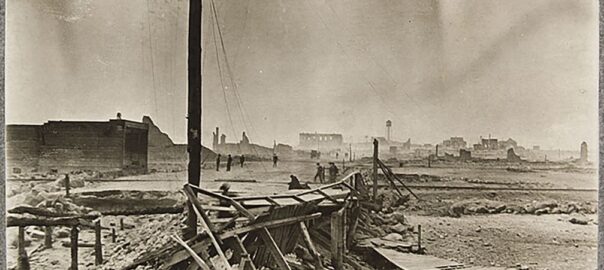
We have another fascinating fragment of a Minnesota-composed song this week. I found the above text in the Minnesota Historical Society’s microfilm copy of the January 3rd, 1895 Pine County Courier newspaper printed in Sandstone, Minnesota. It appeared just four months after the Hinckley Fire which ripped through both Hinckley and nearby Sandstone killing over 400 people.

The paper printed what it said were “a few stanza’s of a song composed by our talented townsman Dan Forin” further stating that “those desiring to secure this song can get it in book form of Dan Forin, Sandstone for 25 cents.”

Much has been written about the Hinckley Fire but I have never come across this song. Daniel Foren appears on the 1895 Minnesota Territorial Census in Sandstone, age 34 with his birthplace listed as Canada. The Courier gives us more information about Dan Forin including that he was the “lone fiddler” at mid-winter dances held at the home of his neighbor Steve O’Neill, an immigrant from Ireland. Forin was also a friend of Patrick Linehan at the time. Born in New York to Irish immigrant parents, Linehan was a fellow Sandstone fire survivor who “sang Irish ballads” at the same parties where Forin played his fiddle. Linehan would later settle in Minneapolis where, in the 1910s, he emerges as the first documented Minnesotan performer on uilleann pipes. Linehan’s set of William Rowsome pipes are now in the hands of Tom Dahill of St. Paul.

Forin and Linehan would have surely known Mike Dean who lived in Hinckley in the 1890s. They may have even been sources for some of the songs in Dean’s songster The Flying Cloud.

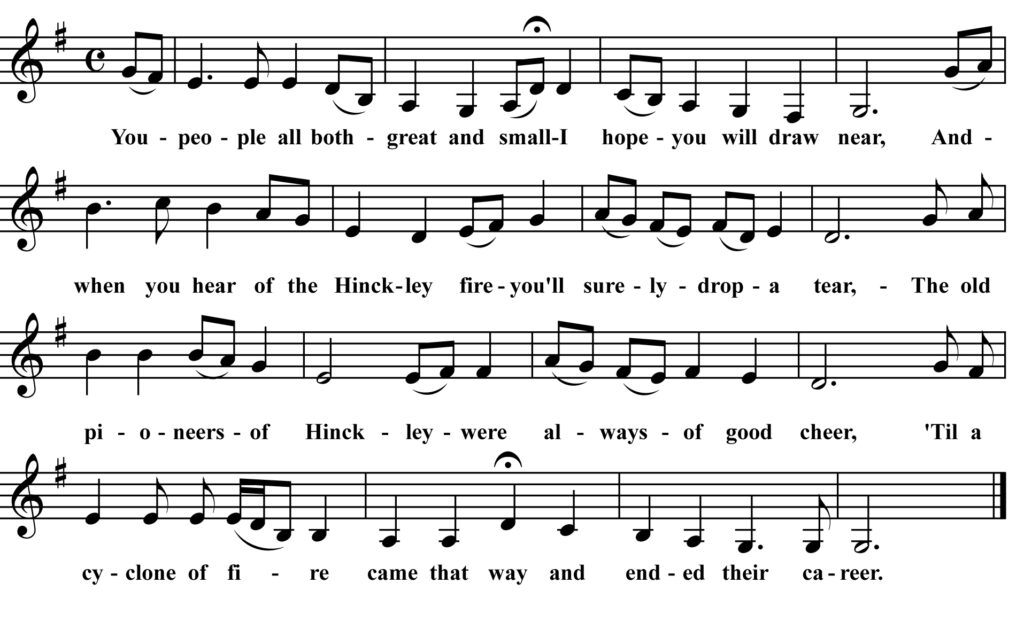
For a tune, I adapted the melody from the Newfoundland song “Gull Cove” as printed in the book Come and I will Sing You by Genevieve Lehr and Anita Best.

For more on Linehan, see this talk I gave during the 2026 Irish Arts Week at Celtic Junction Arts Center